Automation Starts with Observation.
The AIFA Financial Intelligence Platform.
Born from observing café closing routines, AIFA eliminates repetitive SME bookkeeping by converting physical invoices into structured financial ledgers via Vision OCR and multi-agent orchestration.
The Invisible Operational Chaos Behind Cozy Local Cafés.
Indonesia is home to over 65 million SMEs contributing 61% of national GDP, yet more than 90% still manage daily finances manually. While frequently working from local coffee shops in Semarang, I noticed a painful ritual customers never see: after closing the doors, staff spent nearly an hour gathering crumpled paper receipts from bags and chat screenshots, cross-referencing cash drawers, and manually typing numbers into disorganized Excel spreadsheets. At month-end, compiling financial reports consumed one to two full working days. This friction wasn't just a nuisance—it caused frequent calculation errors, lost expense records, and distorted cash flow tracking. Because their books were inaccurate, these thriving small businesses remained ineligible for formal bank credit and business growth funding.
Key Friction Points
- Fragmented Expense Sources: Paper receipts, thermal printouts, supplier WhatsApp invoices, and bank transfer screenshots scattered with no single repository.
- Closing Time Double-Entry Burden: Purchasing staff losing 45–60 minutes every night manually copying prices and line items into spreadsheets.
- Data Inaccuracy & Financial Blind Spots: Typos and missing thermal receipts lead to inaccurate cost-of-goods-sold (COGS) and blind pricing decisions.
- High Cognitive Burden of Complex ERPs: Existing enterprise accounting software is too bloated, costly, and complex for non-technical SME staff.
Engineering Objectives
- Build an unobtrusive '1-snap' receipt ingestion flow that turns unstructured receipt images into structured ledger entries.
- Automate semantic expense categorization (Raw Materials, Operations, Utilities, Stock) without manual rule setups.
- Deliver real-time cash flow dashboards and export-ready financial summaries for SME owners.
- Validate usability and business viability directly with local Semarang F&B café purchasing staff.
Key Engineering Metrics
Direct on-site observation of closing routines, receipt handling, and purchasing workflows across local F&B businesses in Semarang.
Selected as National Finalist at Institut Teknologi Bandung for innovative multi-agent AI orchestration applied to SME operations.
Pre-processing, Google Vision OCR, Gemini semantic classification, and relational database reconciliation.
Eliminates nightly manual transcriptions by directly streaming parsed receipt items into organized ledger categories.
Architectural Evolution: Legacy vs Modern
Staff collect crumpled thermal receipts in physical bags and manually retype line items into Excel every night.
Snap a photo via mobile or web; Google Vision OCR extracts vendor, date, line items, and totals in seconds.
Manual guesswork where different staff members tag items inconsistently across separate sheets.
LLM semantic reasoning automatically maps extracted line items into standardized accounting buckets (COGS, Ops, Utilities).
Owner must wait 1–2 days at month-end for staff to reconcile missing receipts, check bank records, and build summary decks.
Live dashboard updates continuously as receipts are verified, providing instant cash flow and expense analytics.
Faded thermal text and manual typing mistakes lead to unnoticed financial discrepancies and inaccurate tax reporting.
Interactive side-by-side OCR review UI highlights low-confidence fields for quick 1-tap confirmation before commit.
Scope Discipline: Solve One Core Operational Bottleneck Exceptionally Well.
During early ideation for the Arkavidia ITB hackathon, the team proposed an all-in-one 'Super Assistant' with automated business proposal drafting, employee shift optimization, and predictive inventory forecasting. As Product Strategist, I pushed the team to narrow our focus to the single highest-friction problem: document understanding and receipt reconciliation.
Broad Business 'Super Assistant' (Proposals + Scheduling + Inventory)
Attempting to build automated proposal generators, staff scheduling algorithms (Google OR-Tools), and AI financial advice simultaneously.
Focused Receipt Intelligence & Live Cash Ledger Platform
Relentlessly focus on the 4-step OCR + NLP invoice scanning pipeline, structured expense categorization, and clean real-time financial dashboards.
Rationale: Option B allowed us to deliver an impeccably functional MVP. Presenting a deep, production-grade document intelligence platform rather than a shallow prototype with too many half-baked features is what secured our place as National Finalists at Arkavidia ITB.
Four-Tier Applied AI Financial Pipeline Architecture.
How AIFA orchestrates document computer vision, semantic language processing, relational ledger persistence, and interactive review interfaces.
Layer 1: Capture & Pre-Processing UI (@/apps/web-client)
Receipt Image Capture & Side-by-Side ReviewMobile and web capture interface featuring image quality checks, bounding box overlays, and editable extraction review forms.
ReceiptUploadPayloadBoundingBoxOverlayVerifiedExpenseFormLayer 2: Vision OCR & Text Normalization (@/services/ocr)
Optical Character Recognition & Text ExtractionExtracts raw text blocks, coordinates, total values, timestamps, and merchant names with confidence scoring.
RawOCRTextBlockNormalizedReceiptDataConfidenceMetricsLayer 3: Semantic LLM Categorization Engine (@/services/ai)
Chart of Accounts Mapping & Anomaly DetectionInterprets unstructured product line items and maps them into standard accounting categories (COGS, Ops, Utilities) without rigid regex rules.
SemanticClassificationPromptStructuredExpenseRecordTaxCalculationSchemaLayer 4: Relational Ledger & Analytics Store (PostgreSQL)
ACID Ledger Persistence & Cash Flow AggregationsMaintains balanced double-entry accounting records, merchant expenditure histories, and real-time cash flow chart datasets.
LedgerTransactionEntityMonthlyCashFlowSummaryMerchantExpenseHistoryCore Modules & Technical Implementations.
Deep dive into the specific systems designed to convert chaotic physical receipts into audit-grade financial records.
4-Stage Vision OCR & Document Pre-Processing Pipeline
Thermal café receipts are notorious for low contrast, creases, and fading ink. AIFA applies client-side canvas thresholding and contrast normalization before sending images to Google Vision OCR, ensuring high text extraction reliability across low-light camera captures.
- Canvas-based image contrast enhancement handles faded thermal receipts
- Extracts vendor name, transaction date, line items, and total amount accurately
Semantic LLM Chart-of-Accounts Classifier
Traditional regex scripts fail when item names vary (e.g. 'Fresh Milk 1L' vs 'Susu Diamond 1000ml'). AIFA uses Gemini AI orchestrated with LangChain to classify items into structured expense categories (Raw Materials, Bar Supplies, Maintenance, Utilities) automatically.
- Understands unstructured product slang without manual regex maintenance
- Formats outputs strictly into typed JSON schemas for database persistence
Side-by-Side Human-in-the-Loop Verification UI
To maintain 100% financial audit trust, AIFA provides an interactive review interface. The user sees the original receipt image on the left with interactive bounding boxes and the extracted form on the right, highlighting low-confidence values for quick 1-tap correction.
- Side-by-side viewport eliminates context switching between paper and screen
- 1-tap field correction before final commit to accounting ledgers
Live Cash Flow & Real-Time Expense Analytics Dashboard
Eliminates month-end report panic by continuously compiling verified receipts into category distribution charts, supplier price trend tracking, and export-ready monthly financial summaries tailored for SME owners.
- At-a-glance visualization of primary cost drivers across inventory and operations
- Export-ready summaries suitable for bank financing and KUR loan applications
Product Proof & System Interface Artefacts.
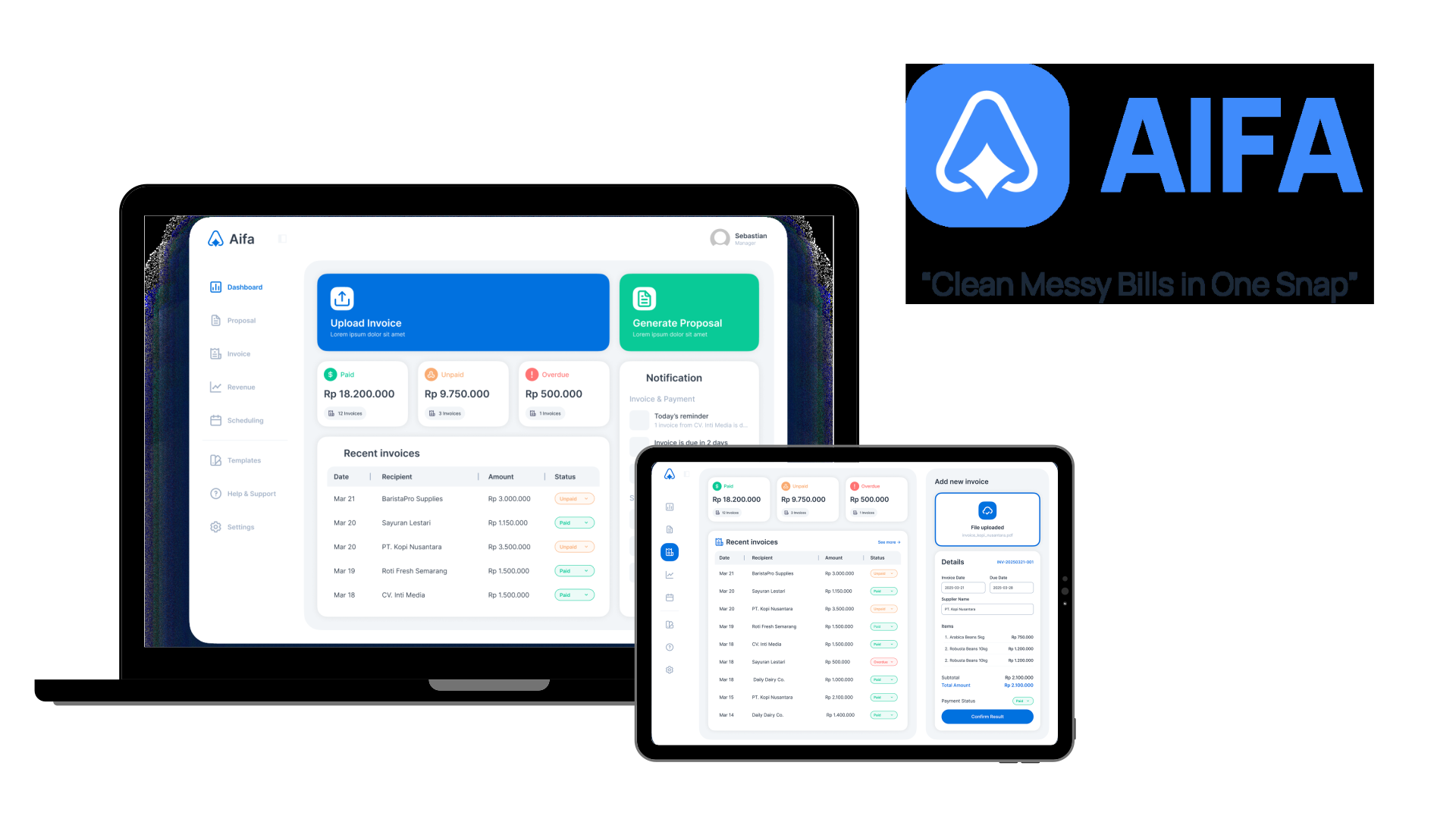
Visual proof of the AIFA receipt ingestion flow, interactive verification workspace, and real-time SME financial analytics dashboard.
Figure 1.0: AIFA end-to-end interface — document scan ingestion, side-by-side extraction verification, and real-time expense breakdown dashboard.
Asset Note: Hackathon presentation pitch deck, live demonstration video, and Arkavidia ITB national finalist certificate are archived in the engineering project repository.
Identified nightly closing double-entry bottleneck in Semarang.
Transforms unstructured photos into clean structured ledgers.
Recognized nationally for practical SME Applied AI innovation.
Verified Outcomes & Competition Accolades.
Measurable validation, product rigor, and competition accolades achieved through disciplined problem-solving and user-centric engineering.
Arkavidia ITB National Finalist Recognition
Selected as National Finalist at Institut Teknologi Bandung out of competitive submissions across Indonesia for our disciplined SME financial intelligence architecture.
Direct F&B Purchasing Workflow Validation
Tested interactive side-by-side scanning UI with local café purchasing staff in Semarang, validating that receipt processing was intuitive for non-technical users.
Zero Unnecessary Dependency Bloat
Successfully eliminated 3 unneeded speculative features (auto-proposals, complex ERP scheduling) to focus 100% of engineering effort on bulletproof receipt extraction.
Applied AI Multi-Agent Architecture
Engineered a seamless bridge connecting Google Vision computer vision with LangChain and Gemini LLM semantic reasoning under clean TypeScript contracts.
"AIFA stood out because it didn't try to build AI for AI's sake. Starting from the unglamorous, everyday reality of SME receipt clutter and building an intuitive, disciplined document intelligence workflow demonstrated true product maturity."
"Great products aren't conceived in brainstorm rooms. They are discovered by watching real people struggle with mundane tasks when they think no one is looking."
AIFA reinforced my core belief in observational product discovery. The most painful bottlenecks in small business operations rarely look like glamorous high-tech problems—they look like crumpled thermal receipts in a plastic bag at 11 PM. Product leadership is about recognizing these unglamorous friction points and applying advanced technology (OCR + LLMs) in the simplest, most invisible way possible.
Key Takeaways
- Observe before you architect: The most valuable product insights come from watching daily end-of-day operational friction in the field.
- Prune scope ruthlessly: A sharp product that solves one painful workflow 10x better always wins over a bloated 'all-in-one' platform.
- Keep the AI invisible: Non-technical users don't care about prompts or model weights—they care about accurate numbers and saved time.