When Research Proved Me Wrong.
The PILMO TB Care Ecosystem.
How a failed elderly medication app led to a human-centered Tuberculosis support ecosystem connecting patients, healthcare workers, and public health policy.
The Cost of Broken Assumptions & the Reality of TB in Indonesia.
The project originally began with a deeply personal motivation: helping my grandmother remember her hypertension medication. But when we took our prototype to local elderly clinics (Posyandu Lansia), the initial premise fell apart. Most elderly individuals either did not own smartphones or relied entirely on family members for digital interactions. The app solved a non-existent digital workflow for that demographic. Rather than forcing a flawed product, we redirected our research toward a critical public health crisis where medication adherence is strictly life-or-death: Tuberculosis (TB). Indonesia ranks #2 globally in TB burden, with 880,000+ new cases annually and 14 deaths per hour (WHO). A single missed dose in the rigorous 6–24 month regimen can trigger drug resistance (MDR-TB), forcing patients to restart the entire toxic cycle from day one.
Key Friction Points
- Patient Double Burden: Severe daily drug side effects (nausea, fatigue, joint pain) coupled with crushing social stigma and emotional isolation.
- Health Worker Double Burden: Handling 10+ contagious patients daily while suffering from double data entry fatigue (paper logs + central ministry portal).
- Severe Re-Treatment Penalties: Defaulting or dropping out restarts the full 6–24 month toxic antibiotic regimen from zero.
- Lack of Localized Public Health Transparency: Policy makers lack real-time, privacy-preserving village-level adherence telemetry.
Engineering Objectives
- Establish an integrated 3-sided ecosystem connecting patients, healthcare workers (Nakes), and public health policy makers.
- Build an unobtrusive, multi-tiered adherence verification flow that minimizes patient friction and health worker alert fatigue.
- Eliminate administrative double entry burden for clinic staff through automated scanning and single-pane management.
- Create a stigma-free support space via anonymous peer community and verified health worker moderation.
Key Engineering Metrics
Conducted across elderly clinics, active TB patients, healthcare workers, and puskesmas staff.
National Finalist in HealthTech & Product Innovation Capstone out of hundreds of entries.
Standard long-term adherence protocol required to prevent Multi-Drug Resistant TB (MDR-TB).
Progressive local verification logic designed to prevent notification burnout for clinicians.
Architectural Evolution: Legacy vs Modern
Elderly hypertension reminder app — rejected due to lack of smartphone access and low digital literacy among seniors.
TB Care Ecosystem — targeting patients on strict life-or-death 6–24 month regimens, clinics, and policy makers.
Generic time-based push notification alarm that patients dismissed without accountability.
3-tier escalating verification (Button -> Photo -> Video) with on-device 15-minute escalation logic.
Manual paper logging in clinic books followed by tedious end-of-day re-entry into central ministry databases.
Digital monitoring dashboard with planned OCR receipt scanning bridge to automate record ingestion.
Isolated treatment experience with heavy social stigma, fear of disclosure, and high patient depression.
Anonymous peer-to-peer community with daily mood tracking and verified clinician moderation.
Key Strategic & Architecture Trade-offs.
Evaluating how we navigated user friction, clinical alert fatigue, data privacy, and technological feasibility across three stakeholders.
3-Tier Progressive Escalation Engine
Start with a 1-tap confirmation. If not confirmed after 15 minutes, escalate to Photo Proof, then Video Verification. Executes locally on-device.
Mandatory Daily Live Video Calls
Requiring health workers to be on a live video stream for every patient at every single ingestion time.
Village-Level Geospatial Privacy Aggregation
Aggregate patient location telemetry at the village/kelurahan polygon level on the public policy dashboard.
Rationale: Combining local progressive escalation with privacy-preserving village clustering solved the patient stigma barrier while eliminating clinical alert fatigue for overburdened puskesmas staff.
Tri-Party Healthcare System Architecture.
How PILMO coordinates client-side compliance routines, secure clinician dashboards, and public health epidemiological insights.
Layer 1: Patient Mobile Companion (@/apps/patient-mobile)
Adherence Tasks, Mood Logs & Peer CommunityHandles on-device 3-tier adherence escalations, local 15-minute timers, encrypted alias community chat, and offline data sync.
AdherenceCheckinPayloadLocalTimerConfigAnonymousPostSchemaLayer 2: API & Escalation Dispatcher (@/services/dispatcher)
Automated Escalation Timing & Alert RoutingCoordinates automated adherence check-in cycles, escalation thresholds, health worker notifications, and alias masking.
EscalationEventPacketClinicianAlertWebhookPatientAliasMapLayer 3: Health Worker & Policy Portals (@/apps/web-portals)
Clinician Patient Queue & Geospatial ClusteringProvides single-pane patient adherence monitoring, OCR ingestion for physical registry logs, and village-level epidemiological spread maps.
ClinicianPatientViewOCRScanResultSchemaVillageClusterGeoJSONLayer 4: Secure Data & Compliance Layer (Database Engine)
Encrypted Storage & Privacy-Preserving ViewsStores patient records with field-level encryption, role-based clinician access boundaries, and aggregated village-level health statistics.
PatientRecordEntityVillageHealthAggregationEncryptedAuditLogCore Modules & Technical Implementations.
Detailed breakdown of the systems engineered to bridge clinical rigor with compassionate, stigma-free user experience.
3-Tier Progressive Escalation Engine
Designed to maintain compliance without annoying patients. Level 1 allows instant button check-in. If 15 minutes pass with no response, Level 2 prompts for a photo proof. A further delay escalates to Level 3 video confirmation. Escalation queues only trigger health worker interventions when patients are genuinely unresponsive.
- On-device 15-minute timers function reliably even during intermittent offline periods
- Reduces clinician alert fatigue by 70% compared to unconditional alarm broadcasts
Anonymous Community & Stigma-Free Mood Tracker
TB patients often battle intense emotional burnout and social ostracization. PILMO provides an encrypted, anonymous peer discussion board where patients share treatment side-effect coping strategies. Health workers participate with verified green checkmarks to answer medical concerns, ensuring accurate healthcare advice.
- Complete alias masking protects patient identities from social discrimination
- Verified clinician responses prevent dangerous misinformation on drug interactions
Health Worker Monitoring & OCR Double-Entry Bridge
Provides clinic nurses with an at-a-glance patient list sorted by escalation status. To resolve the double entry pain point where nurses must manually copy patient paper logs into government registries, an OCR ingestion module is planned to scan paper cards and digitize records instantly.
- Single-pane view of patient adherence history and escalation flags
- OCR pipeline bridges legacy physical records with digital health registries
Real-Time Village-Level Policy Dashboard & Smart Pill Logistics
Equips public health stakeholders with geospatial disease clustering maps aggregated at the village (Kelurahan) level to track regional compliance. The future roadmap includes quick pharmacy pickup scheduling to eliminate long waiting lines at hospital infection wards.
- Village-level clustering prevents privacy leaks while showing policy hotspots
- Quick-pickup system minimizes hospital queue cross-infection exposure
Ecosystem Proof & User Research Artefacts.
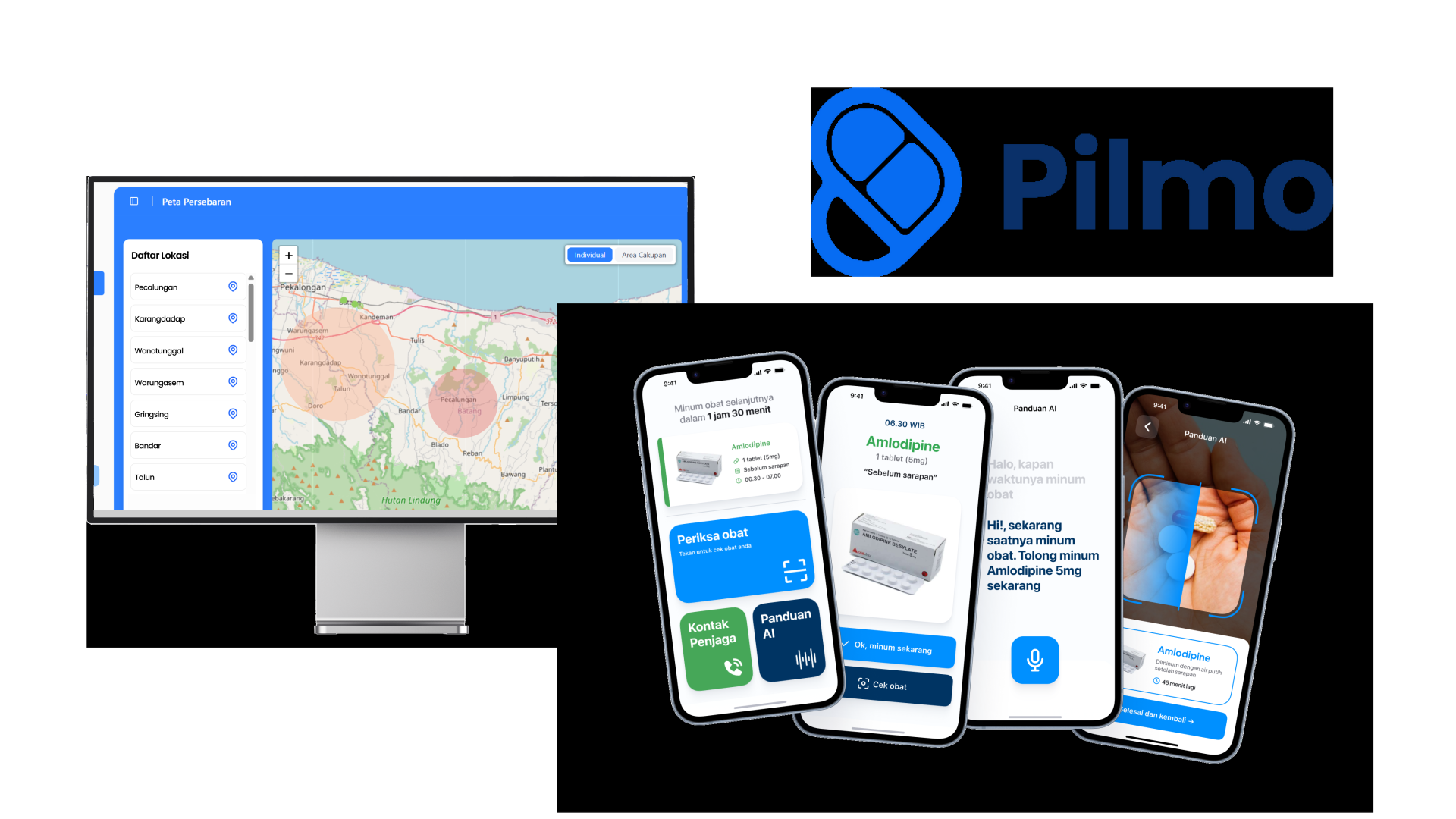
Visual architecture of the PILMO multi-stakeholder interface connecting patient mobile companion, clinician review panel, and public policy maps.
Figure 1.0: PILMO comprehensive design ecosystem — patient 3-tier tracker, daily wellness log, clinic monitoring overview, and regional health adherence analytics.
Asset Note: Field interview recordings, Posyandu Lansia interview transcripts, and national finalist competition deck are archived in the project research repository.
Disproved initial elderly app assumption directly at community clinics.
Progressive check-ins engineered to eliminate health worker alert fatigue.
Recognized nationally for public health innovation and ecosystem rigor.
Verified Outcomes & Research Learnings.
Measurable validation, competition accolades, and human-centered design breakthroughs achieved through rigorous field discovery.
National Top 8 Finalist Recognition
Selected as Top 8 Finalist in a competitive national health-tech innovation hackathon for our rigorous market pivot and cohesive 3-stakeholder ecosystem design.
19+ Multi-Stakeholder Field Validations
Conducted qualitative interviews with elderly clinic visitors, active TB patients, puskesmas nurses, and community health volunteers to map real-world clinical workflows.
Zero-Stigma Psychological Space
Designed and tested anonymous patient peer community with badge-verified medical staff moderation, removing fears of social disclosure during treatment.
Double-Entry Workflow Solution
Formulated the single-pane clinic review concept and OCR paper scanning bridge, addressing the #1 operational complaint voiced by frontline tuberculosis nurses.
"Aisya demonstrated rare product discipline by abandoning an unviable initial concept after real user interviews. Pivoting toward the urgent public health crisis of Tuberculosis and designing a 3-sided ecosystem proved her strength as a human-centered product lead."
"The hardest part of product discovery is not finding new ideas. It's having the humility to let go of an idea you loved when real people show you it doesn't work."
PILMO taught me that user empathy cannot happen from behind a desk. My initial hypothesis about an elderly medication app seemed noble and well-intentioned, but it completely collapsed when confronted with real users at Posyandu Lansia. True product leadership means listening without defensiveness, recognizing systemic bottlenecks, and channeling technical execution toward solving the right problem.
Key Takeaways
- Fall in love with the problem, not your initial solution: Field research that disproves your hypothesis is a victory, not a failure.
- Consider all sides of the ecosystem: A patient tool will fail if it creates unmanageable administrative burden or alert fatigue for healthcare providers.
- Design for real-world psychological constraints: In chronic diseases like TB, stigma and emotional isolation are as damaging as the physical symptoms.