Designing for Critical Moments.
The OneCall Emergency Ecosystem.
Born from a street crime tragedy in Semarang, OneCall reimagines rapid emergency reporting through screen-less hardware triggers, SMS fallbacks, and a volunteer first-responder network.
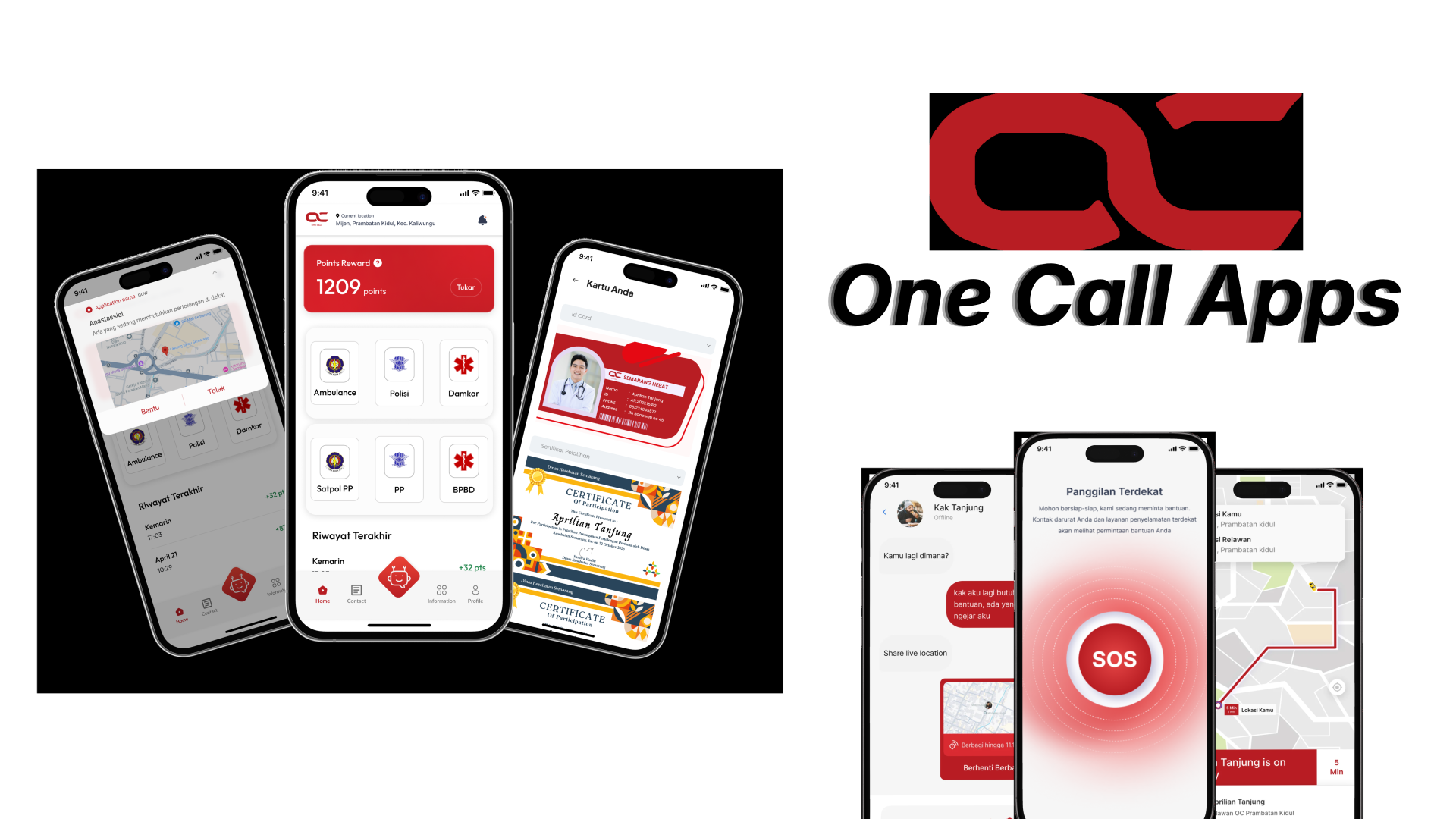
When Panic Strikes, Traditional Apps Become Useless.
The project was sparked by a heartbreaking tragedy in Semarang: a university peer lost his life in a violent late-night street gang assault ('kreak'). In a sudden physical attack or medical collapse, victims experience acute cognitive overload and extreme motor impairment. Expecting a victim to unlock a smartphone, search through an app drawer, choose between 5 different emergency numbers, and type an address is a dangerous design flaw. Furthermore, Indonesia's emergency response is plagued by fragmented agency numbers: Police (110), Ambulance (118/119), Fire (113), and SAR (115). Victims rarely know which to call under stress, and cellular data frequently drops in alleyways. The core realization: in an emergency, the best UI is no UI, and the fastest help comes from nearby community first-responders rather than bureaucratic call centers.
Key Friction Points
- Extreme Cognitive & Motor Overload: Victims under physical threat cannot perform multi-step smartphone UI interactions.
- Fragmented Emergency Infrastructure: Multiple disconnected hotlines create confusion and critical dispatch delays.
- Cellular Connectivity Blank Spots: Packet internet often drops in dark alleys, failing cloud-only panic buttons.
- Bureaucratic Integration Bottleneck: Integrating directly with all municipal government agencies requires years of red tape.
Engineering Objectives
- Engineer a screen-less hardware trigger (5× power button clicks) that broadcasts distress without waking the phone screen.
- Establish an automated SMS fallback protocol that transmits GPS telemetry even when cellular packet data is offline.
- Bypass government call-center bureaucracy by routing live beacons to nearby verified community volunteer first responders.
- Validate response-time feasibility with community volunteers, ambulance crews, and university students.
Key Engineering Metrics
Won 3rd Place Nationally at FOSTIFEST 2024 and 3rd Place Nationally at INVOFEST 2024 for pragmatic civic-tech innovation.
Conducted interviews and user testing with community emergency volunteers, healthcare workers, and student commuters.
Android Accessibility hardware key hook enables silent, blind distress activation directly from pockets.
Primary high-speed WebSocket telemetry with automatic cellular SMS payload dispatch for zero signal dropouts.
Architectural Evolution: Legacy vs Modern
Victim must unlock phone, find and open a panic app, choose emergency category, and press a large on-screen button.
Victim clicks the physical power button 5 times inside their pocket; distress signal fires silently without lighting the display.
Centralized municipal call centers that require long multi-agency routing and identity verification queues.
Crowdsourced volunteer network alerts verified community responders within 1–2 km radius for instant on-scene assistance.
Cloud-only emergency apps fail silently when cellular 4G/5G internet drops in dark alleys or rural roads.
Dual-layer fallback: if WebSocket connection fails, coordinates are automatically packed into an encrypted SMS packet.
Family contacts, police, and clinics notified through disconnected phone calls with no shared live telemetry.
Single shared dispatch dashboard showing real-time GPS coordinates, victim battery level, and responder ETA.
Strategic Pivot: Bypassing Bureaucracy Through Volunteer Crowdsourcing.
Inspired by emergency response dramas, our original ambition was to build a single master government call center connecting police, firefighters, and hospitals into one API. However, after validating with municipal stakeholders and health workers, we realized inter-agency bureaucracy would take years to approve. As Product Strategist, I led the strategic pivot to crowdsourced community first-responders.
Centralized Government Multi-Agency Integration
Waiting for municipal permits and attempting to force police, fire, and hospitals into a single centralized digital gateway.
Community Volunteer First-Responder Model + SMS Fallback
Empower verified citizen volunteer groups (SAR, PMI, local safety patrols) as immediate first responders while broadcasting automated SMS fallbacks.
Rationale: Option B was the most pragmatic, human-centered decision. By pairing a screen-less 5× power button hardware trigger with nearby volunteer dispatch, we created a functioning emergency lifeline that won 3rd Place Nationally at both FOSTIFEST and INVOFEST 2024.
Four-Tier Resilient Emergency Telemetry Architecture.
How OneCall bridges silent mobile OS hardware triggers, dual-channel socket/SMS transmission, real-time spatial volunteer dispatching, and secure incident audit logs.
Layer 1: Screen-less Trigger Client (@/apps/emergency-mobile)
Hardware Key Interceptor & Background GPS AcquisitionIntercepts rapid physical power button presses in the background, captures precision GPS coordinates, and fires silent distress beacons without waking the display.
HardwarePanicEventPrecisionLocationPayloadDeviceTelemetryPacketLayer 2: Dual-Channel Telemetry & SMS Fallback Gateway
WebSocket Broadcast & GSM SMS Cellular RoutingStreams sub-second live location packets to active volunteer dispatchers. If WebSocket handshake drops, automatically transmits encrypted NMEA SMS packets.
EmergencyBroadcastEventSMSPayloadSchemaConnectionHeartbeatLayer 3: Volunteer Spatial Dispatch Portal (@/apps/dispatcher-web)
Geofenced Proximity Alerts & Turn-by-Turn RoutingInteractive web dashboard for verified volunteer command centers, sorting active incidents by proximity and providing turn-by-turn routing to the victim.
VolunteerIncidentQueueRoutingDirectionPacketIncidentStatusDeltaLayer 4: Incident Ledger & Public Safety Audit Store (PostgreSQL)
Encrypted Evidence Vault & Spatial Incident HistoriesPersists incident timestamps, responder telemetry, audio snippets, and verified resolution logs with strict data retention and privacy policies.
IncidentAuditEntityResponderTelemetryRecordSpatialCrimeClusterCore Modules & Technical Implementations.
Technical breakdown of the hardware, network, and human systems engineered to minimize time-to-assistance during critical emergencies.
Screen-less 5× Hardware Key Panic Trigger
Using an Android Accessibility Service background hook, OneCall listens for 5 consecutive power button presses within 3 seconds. The trigger executes silently without activating the screen, vibration motor, or speaker, allowing victims to request help secretly during physical assaults.
- 100% blind pocket activation without unlocking smartphone screen
- Zero sound or screen flare prevents escalating danger during physical attacks
Dual-Path Resilient SMS Fallback Gateway
Recognizing that attackers often drag victims into cellular internet blank spots (alleys, underpasses), OneCall implements a dual-path engine. If packet internet (WebSocket) fails within 5 seconds, the mobile client compresses coordinates into a structured SMS and broadcasts to designated emergency gateways.
- Automatic failover to cellular SMS when 4G/5G data connection is severed
- Encrypted payload contains latitude, longitude, timestamp, and battery percentage
Volunteer First-Responder Proximity Dispatch Portal
An interactive Next.js command dashboard for verified community emergency teams (SAR, PMI, university security). Incoming alerts are rendered on a live Leaflet map with distance sorting, instant acoustic sirens, and one-click turn-by-turn navigation to the victim's live coordinates.
- Instant spatial routing connects victims to help within a 1–2 km radius
- Verified volunteer badges prevent vigilantism and protect victim safety
AI Voice Keyword & Geofenced High-Risk Safe Walk Mode
[PROPOSED / CONCEPT] Future expansion adding edge on-device keyword recognition (e.g. scream detection, custom panic phrases) and an active 'Safe Walk' mode that automatically alerts nearby volunteers if a user's late-night transit deviates from historical safe corridors.
- Hands-free voice detection for scenarios where physical power button cannot be reached
- Proactive geofencing alerts for unlit alleyways and documented high-crime clusters
System Proof & National Competition Artefacts.
Visual proof of the OneCall emergency mobile application, volunteer proximity dispatch dashboard, and hardware trigger testing workflows.
Figure 1.0: OneCall ecosystem — screen-less panic trigger sequence, SMS fallback routing, volunteer proximity radar, and turn-by-turn rescue navigation.
Asset Note: FOSTIFEST and INVOFEST 2024 national 3rd-place trophies, jury evaluation scorecards, and live Android Accessibility prototype demo video are archived in the engineering repository.
Silent pocket activation designed for physical panic moments.
Guaranteed transmission even in cellular internet blank spots.
Awarded at FOSTIFEST 2024 and INVOFEST 2024 civic-tech finals.
Verified Outcomes & Competition Accolades.
Measurable accomplishments, podium finishes in national tech competitions, and human-centered design breakthroughs.
Dual 3rd Place National Podiums (FOSTIFEST & INVOFEST 2024)
Awarded 3rd Place Nationally across two major Indonesian software competitions for our pragmatic, screen-less emergency architecture and volunteer crowdsourcing model.
13+ Stakeholder & First-Responder Field Interviews
Conducted qualitative interviews with community emergency volunteers (PMI/SAR), ambulance drivers, and university students to validate emergency activation workflows.
Verified Screen-less Activation & Zero-Light Secrecy
Successfully implemented Android hardware key interception that captures GPS and dispatches distress packets while leaving the smartphone screen completely dark.
Dual-Path Telemetry with Zero Signal Dropouts
Bench-tested seamless failover from WebSocket internet data to cellular SMS gateways, ensuring emergency coordinates reach dispatchers even in zero-data alleys.
"OneCall proved that the best design is often the most invisible one. Bypassing bloated UI screens in favor of an instinctive 5-click physical trigger and routing directly to community volunteers addresses the real-world reality of street emergencies."
"In an emergency, the best UI is no UI, and the best system is the most pragmatic one."
OneCall taught me that extreme constraints produce the purest product design. When building for life-or-death situations, you cannot rely on user attention, smooth animations, or reliable 5G connections. True product strategy means eliminating every unnecessary pixel and bureaucratic dependency until only the fastest, most reliable path to human assistance remains.
Key Takeaways
- Design for panic, not ideal scenarios: High-stress users suffer severe motor and cognitive degradation; UI must require zero visual attention.
- Pragmatism over perfection: Partnering with agile community volunteers delivered immediate rescue speed that bureaucratic government systems couldn't match.
- Always build resilient offline fallbacks: Life-critical applications must never depend exclusively on single points of failure like cellular packet internet.